

Gemini API pricing operates on two tracks: a free tier and a paid tier. As of November 1, 2026, Google AI Studio usage is free in all available regions. Tools are priced separately, and paid tier content is not used to improve Google's products. Two scheduled price increases take effect on December 1, 2026, and January 1, 2027, altering token costs across three models.
How Does Gemini API Pricing Work Across Tiers?
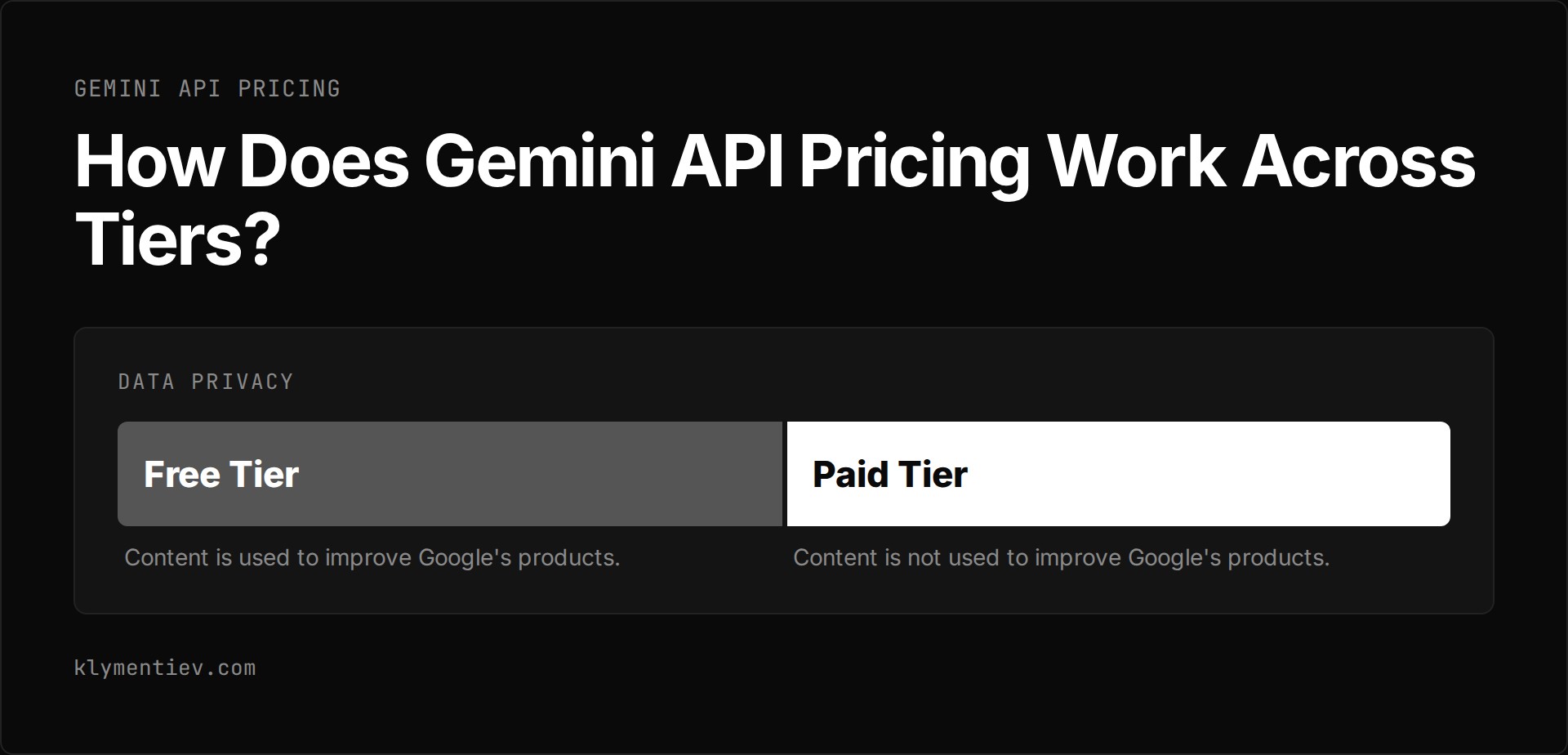
The platform splits access between a free tier and a paid tier. Some models support both options, while others exist only on one. On the free tier, content is used to improve Google's products. On the paid tier, content is not used to improve Google's products.
Token consumption is measured in units of one million tokens for input and output. Standard prompts follow base rates. Batch prices are half of the standard price for every model that lists a batch rate. Context caching is billed per one million cached tokens, plus storage per one million tokens per hour.
Google AI Studio usage is free in all available regions. When you move beyond free allocations, billing follows the schedule posted on the official pricing page, which was last updated on October 30, 2026.
How Much Do the Flagship and Preview Models Cost?
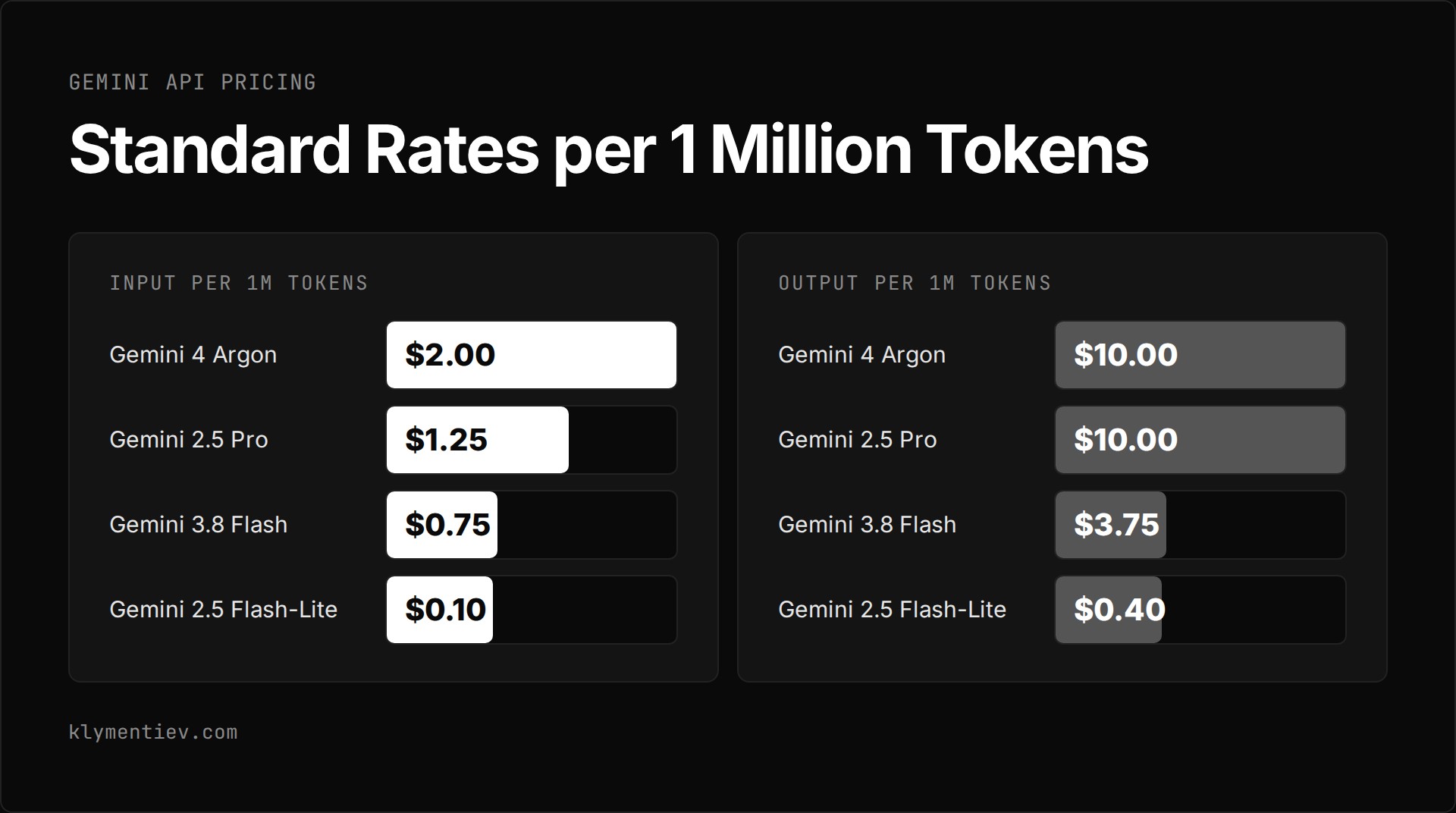
Gemini 4 Argon has no free tier. Standard usage costs $2.00 per million input tokens and $10.00 per million output tokens. Context caching for Argon currently costs $0.10 per million tokens. A scheduled change doubles these rates on December 1, 2026. After that date, Argon input rises to $4.00 per million tokens, output rises to $20.00 per million tokens, and context caching increases to $0.20 per million tokens.
Gemini 3.1 Pro Preview also operates without a free tier. Pricing depends on the length of your prompt. For prompts up to 200,000 tokens, standard rates are $2.00 per million input tokens and $12.00 per million output tokens. Prompts that exceed 200,000 tokens cost $4.00 per million input tokens and $18.00 per million output tokens. If you submit jobs through batch processing, prompts up to 200,000 tokens cost $1.00 per million input tokens and $6.00 per million output tokens.
Gemini 2.5 Pro provides a free tier alongside its paid commercial track. For prompts up to 200,000 tokens, paid pricing is $1.25 per million input tokens and $10.00 per million output tokens. Longer contexts exceeding 200,000 tokens cost $2.50 per million input tokens and $15.00 per million output tokens.
What Are the Rates for Flash and Flash-Lite Models?
Gemini 3.8 Flash and Gemini 3.6 Flash share the exact same pricing structure and both include a free tier. Paid input costs $0.75 per million tokens, while output costs $3.75 per million tokens. Their batch rates are $0.375 per million input tokens and $1.875 per million output tokens. Both models will see their prices double on January 1, 2027. On that date, input becomes $1.50 per million tokens and output becomes $7.50 per million tokens.
Gemini 3 Flash Preview offers a free tier as well. Paid text, image, and video inputs cost $0.50 per million tokens, whereas audio inputs cost $1.00 per million tokens. Output across all modalities costs $3.00 per million tokens.
Gemini 3.5 Flash-Lite includes a free tier and charges $0.30 per million input tokens and $2.50 per million output tokens on the paid tier, with batch processing set at $0.15 for input and $1.25 for output. Gemini 3.1 Flash-Lite sets standard text, image, and video inputs at $0.25 per million tokens, audio inputs at $0.50 per million tokens, and output at $1.50 per million tokens. Its batch rates are $0.125 for input and $0.75 for output.
Gemini 2.5 Flash charges $0.30 per million tokens for standard input, $1.00 per million tokens for audio input, and $2.50 per million output tokens. Gemini 2.5 Flash-Lite is the cheapest paid text model listed on the schedule. It costs $0.10 per million tokens for standard input, $0.30 per million tokens for audio input, and $0.40 per million output tokens. Gemma 4 offers only a free tier with free input, output, and caching, and provides no paid tier at all.
How Are Tools, Grounding, and Media Billed?
Tools are priced separately. For Gemini 3 and newer models, grounding with Google Search includes 5,000 free search requests a month shared across those models. Once you exceed that pool, additional searches cost $14 per 1,000 requests, with a daily cap of 1,500 requests. Google Maps grounding offers 5,000 requests a month free, shared across Gemini 3 and newer, then $14 per 1,000 requests.
For Gemini 2.5 models, grounding with Google Search includes 1,500 free requests per day. Subsequent requests cost $35 per 1,000 grounded prompts. On Gemini 2.5 Flash and Gemini 2.5 Flash-Lite, search grounding is free up to 500 requests a day on the free tier.
Multimodal inputs follow listed rates. PDF pages are billed at the image token rate. For standalone image generation, Gemini 2.5 Flash Image costs $0.039 per image, while Gemini 3.1 Flash Image costs $60.00 per million image output tokens. Neither image generation model has a free tier.
Audio synthesis is available via Gemini 2.5 Flash Preview TTS, which includes a free tier and charges $0.50 per million text input tokens and $10.00 per million audio output tokens on the paid tier. Text embeddings offer a free tier as well. Gemini Embedding costs $0.15 per million tokens, with batch processing at $0.075 per million tokens. Gemini Embedding 2 text costs $0.20 per million tokens.
Which Gemini API Model Fits Your Workload?
The following table summarizes the primary paid models as recorded on November 1, 2026.
| Model | Free Tier | Input per 1M | Output per 1M | Notes |
|---|---|---|---|---|
| Gemini 4 Argon | No | $2.00 | $10.00 | Prices double on December 1, 2026 |
| Gemini 3.1 Pro Preview | No | $2.00 | $12.00 | Rate increases over 200k tokens |
| Gemini 2.5 Pro | Yes | $1.25 | $10.00 | Rate increases over 200k tokens |
| Gemini 3.8 Flash | Yes | $0.75 | $3.75 | Prices double on January 1, 2027 |
| Gemini 3.6 Flash | Yes | $0.75 | $3.75 | Prices double on January 1, 2027 |
| Gemini 3 Flash Preview | Yes | $0.50 | $3.00 | Audio input costs $1.00 per 1M |
| Gemini 3.5 Flash-Lite | Yes | $0.30 | $2.50 | Batch costs $0.15 input and $1.25 output |
| Gemini 3.1 Flash-Lite | Yes | $0.25 | $1.50 | Audio input costs $0.50 per 1M |
| Gemini 2.5 Flash | Yes | $0.30 | $2.50 | Audio input costs $1.00 per 1M |
| Gemini 2.5 Flash-Lite | Yes | $0.10 | $0.40 | Cheapest paid text model on the page |
| Gemma 4 | Yes | Free | Free | Free tier only with no paid tier |
Frequently Asked Questions
When do the scheduled Gemini API price increases take effect?
Gemini 4 Argon doubles in price on December 1, 2026, taking input to $4.00 per million tokens and output to $20.00 per million tokens. Gemini 3.8 Flash and Gemini 3.6 Flash double in price on January 1, 2027, taking input to $1.50 per million tokens and output to $7.50 per million tokens.
What is the primary data privacy difference between free and paid tiers?
On the free tier, content is used to improve Google's products. On the paid tier, content is not used to improve Google's products.
What is the cheapest model available under paid Gemini API pricing?
Gemini 2.5 Flash-Lite is the cheapest paid text model listed on the schedule. It costs $0.10 per million tokens for standard input and $0.40 per million tokens for output.
How does batch processing reduce inference expenses?
For models that support batch processing, requests submitted through the batch API receive a fifty percent discount compared to standard rates. This applies to models such as Gemini 3.8 Flash, Gemini 3.5 Flash-Lite, and Gemini 3.1 Flash-Lite.
