
DeepSeek API pricing operates on an active pay-per-token model with two main models, cache incentives, and variable peak rates. The official documentation reflects model versions DeepSeek-V4.1-Flash-1017 and DeepSeek-V4-Pro-0813 as of 2026-11-01. Both routes provide a 1M token context window and 384K maximum output, while their token rates and concurrency limits diverge. DeepSeek accepts API traffic across both OpenAI and Anthropic format base URLs.
How does deepseek api pricing work for deepseek-flash?
The deepseek-flash model runs the DeepSeek-V4.1-Flash-1017 version and serves as the lower-cost model route. It supports both thinking and non-thinking modes, with thinking mode configured as the default. This model handles a context window of 1M tokens, has a maximum output limit of 384K tokens, and maintains a concurrency limit of 2500. It is the only model listed on the official pricing documentation that supports vision inputs. When evaluating options against guides like /blog/cheapest-llm-api or providers compared in /blog/openrouter-free-tier, token pricing depends on cache status and operating hours.
The deepseek flash price structure relies heavily on whether your prompt hits the context cache. For input tokens that register a cache hit, the rate is $0.003 per 1M tokens during off-peak hours and $0.006 per 1M tokens during peak hours. For input tokens that result in a cache miss, the rate rises to $0.15 per 1M tokens during off-peak hours and $0.3 per 1M tokens during peak hours. Output tokens cost $0.6 per 1M tokens during off-peak hours and $1.2 per 1M tokens during peak hours.
DeepSeek also handles legacy model aliases through this tier. Requests sent under the legacy names deepseek-v4-flash and deepseek-v4-flash-vision-exp are retired, but the API still accepts those identifiers. The platform routes those requests to DeepSeek-V4.1-Flash-1017 and bills them at standard Flash rates. You can verify these specifications directly on the official pricing documentation.
What does deepseek-v4-pro provide and cost?
The deepseek-v4-pro model runs DeepSeek-V4-Pro-0813. Like Flash, it supports both thinking and non-thinking modes, with thinking mode selected by default. It maintains the same 1M token context window and 384K maximum output ceiling, but its concurrency limit is set to 500 rather than 2500. The deepseek-v4-pro model does not support vision inputs.
The deepseek v4 pro price is set higher across all token categories. When input tokens hit the cache, you pay $0.022 per 1M tokens during off-peak hours and $0.044 per 1M tokens during peak hours. If input tokens miss the cache, the price is $0.66 per 1M tokens off-peak and $1.32 per 1M tokens during peak hours. Output tokens are priced at $1.98 per 1M tokens during off-peak hours and $3.96 per 1M tokens during peak hours.
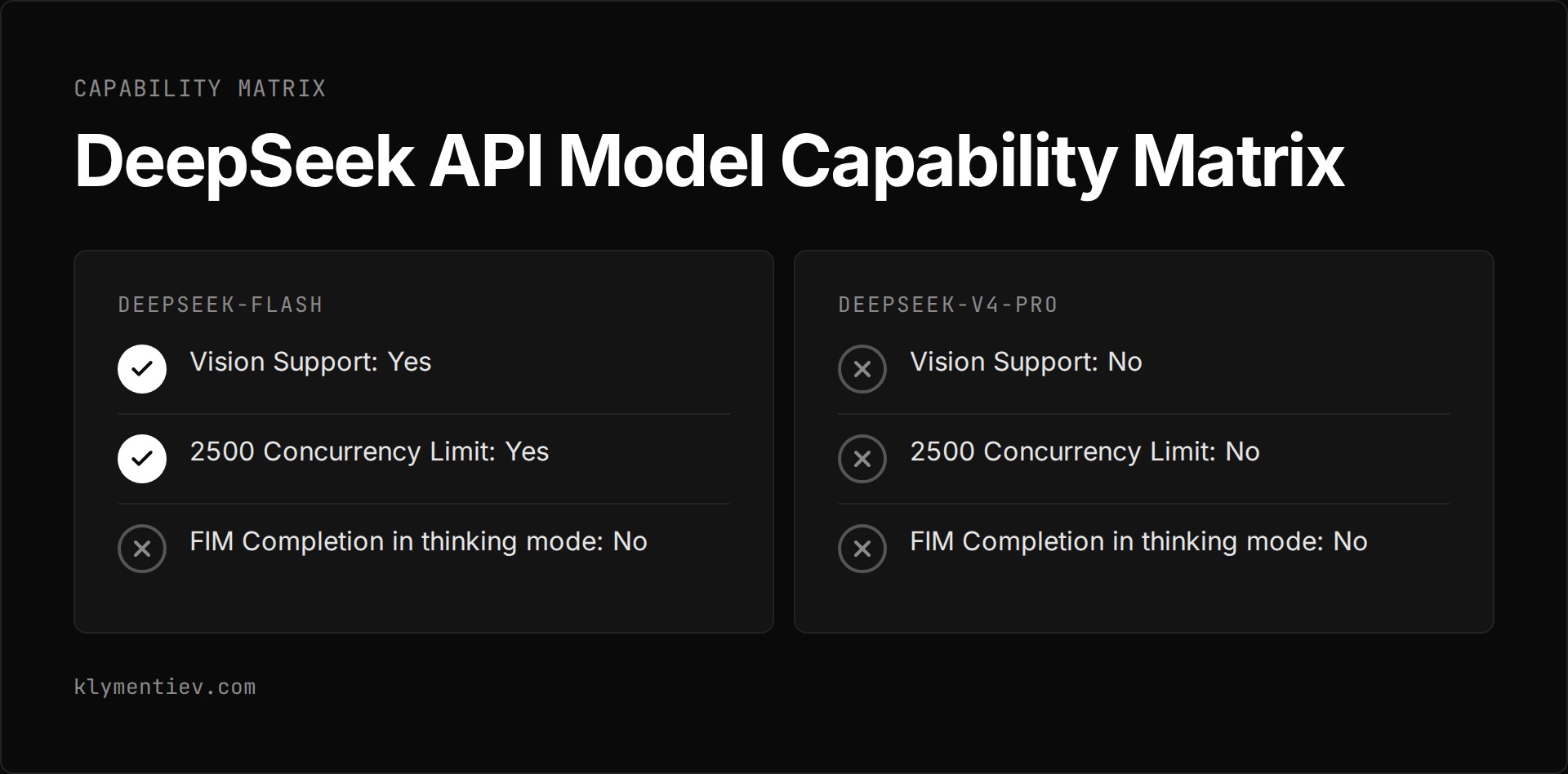
Both models share common feature compatibility across the API. You can use JSON Output, Tool Calls, Responses API, Anthropic API formatting, and Chat Prefix Completion (Beta) on both models. FIM Completion (Beta) works on both models, but it operates in non-thinking mode only. If you route prompts through routers discussed in /blog/llm-gateway-guide or compare them to costs in /blog/claude-api-pricing, these technical distinctions determine your implementation setup.
How do peak hours and tool calls change your deepseek api cost?
Your total deepseek api cost fluctuates depending on the exact schedule of your calls. DeepSeek divides the billing week into peak and off-peak windows based on UTC time. Peak hours run from 01:00 to 04:00 UTC and from 06:00 to 10:00 UTC, Monday to Friday. Peak hours exclude Chinese public holidays.
All other hours qualify for deepseek off-peak rates, which reduce all token prices by exactly half. This off-peak discount applies throughout the entire weekend and covers Chinese public holidays in full. If you run batch jobs outside the two weekday peak windows, token expenses drop fifty percent across both models.
Web retrieval functions introduce separate fees alongside token usage. Search costs $0.75 per 1,000 successful requests, and Fetch costs $0.75 per 1,000 successful requests. Per-request billing starts at 00:00 Beijing time, November 1, 2026. Server-side tool calls originating from DeepSeek Harness, Claude Code, or Codex currently incur no charge.
Integration happens over two distinct base URLs. Standard OpenAI format requests go to https://api.deepseek.com, while Anthropic format requests go to https://api.deepseek.com/anthropic. For billing settlement, cost equals tokens multiplied by price. Fees are deducted from the topped-up balance or the granted balance, with granted balances consumed first whenever both exist. Prices may change because DeepSeek reserves the right to adjust them. The official page states no free tier and no free credit amount.
Which model route fits your technical requirements?
Choosing between the two models requires balancing concurrency limits, vision requirements, and token costs across cache states. Concurrency limits are detailed further on DeepSeek's separate Rate Limit and Isolation page, but the main pricing documentation lists clear operational differences.
| Feature or Rate | deepseek-flash | deepseek-v4-pro |
|---|---|---|
| Underlying Version | DeepSeek-V4.1-Flash-1017 | DeepSeek-V4-Pro-0813 |
| Context Window | 1M tokens | 1M tokens |
| Maximum Output | 384K tokens | 384K tokens |
| Concurrency Limit | 2500 | 500 |
| Vision Support | Yes | No |
| Default Mode | Thinking | Thinking |
| Off-peak Cache Hit Input (per 1M) | $0.003 | $0.022 |
| Peak Cache Hit Input (per 1M) | $0.006 | $0.044 |
| Off-peak Cache Miss Input (per 1M) | $0.15 | $0.66 |
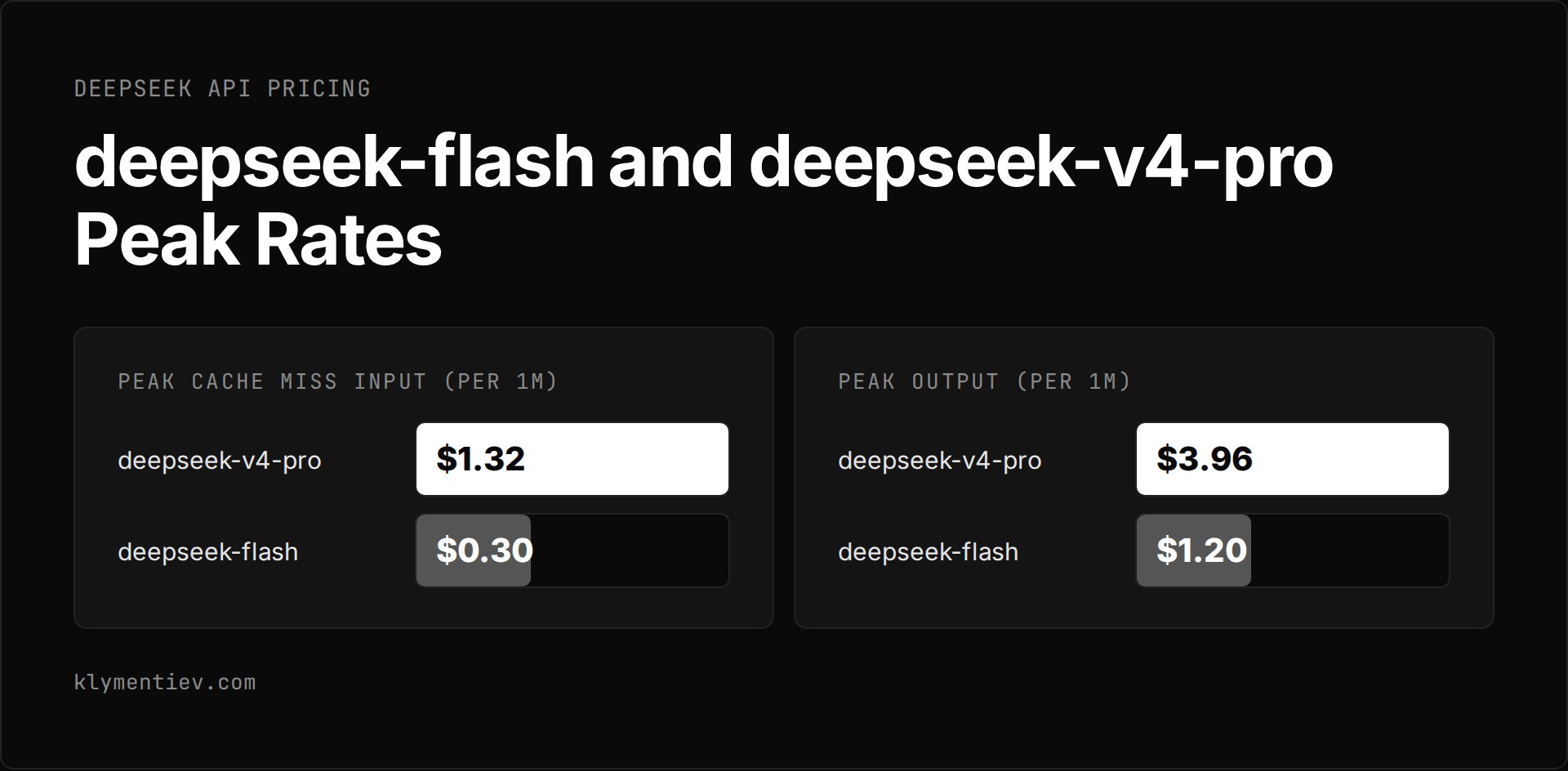
| Peak Cache Miss Input (per 1M) | $0.30 | $1.32 |
| Off-peak Output (per 1M) | $0.60 | $1.98 |
| Peak Output (per 1M) | $1.20 | $3.96 |
Only vision workloads require deepseek-flash, as deepseek-v4-pro lacks image input capabilities entirely. For teams managing high concurrent traffic, deepseek-flash offers a higher concurrency limit of 2500 compared to 500 on deepseek-v4-pro. Comparing these figures against alternative providers in /blog/groq-pricing or no-cost options in /blog/gemini-api-free-tier helps evaluate balance burn rates.
Frequently asked questions
Does the DeepSeek API provide a free tier?
The official pricing documentation states no free tier and no free credit amount. Fees are deducted from the topped-up balance or the granted balance, with the granted balance used first when both exist. If you want zero-cost options, check alternatives in /blog/best-free-llm-2026.
How does prompt caching lower your deepseek api pricing?
Prompt caching cuts input rates significantly on both models. On deepseek-flash, a cache hit drops your input token rate to $0.003 off-peak and $0.006 peak, compared to $0.15 off-peak and $0.3 peak for misses. On deepseek-v4-pro, a cache hit lowers costs to $0.022 off-peak and $0.044 peak, compared to cache miss rates of $0.66 off-peak and $1.32 peak.
Which model supports vision processing?
Only deepseek-flash supports vision inputs. The deepseek-v4-pro model does not support vision processing. If you send requests to the retired deepseek-v4-flash-vision-exp alias, DeepSeek serves them through DeepSeek-V4.1-Flash-1017 at regular Flash pricing.
What are the limits on thinking mode and tool features?
Thinking mode is the default state on both deepseek-flash and deepseek-v4-pro, though non-thinking mode is available on both. JSON Output, Tool Calls, Responses API, Anthropic API formatting, and Chat Prefix Completion (Beta) function across both models. FIM Completion (Beta) works on both models as well, but operates in non-thinking mode only.
Exactly when do off-peak rates apply?
Off-peak pricing applies outside 01:00 to 04:00 UTC and 06:00 to 10:00 UTC, Monday to Friday. The entire weekend runs on off-peak rates. Chinese public holidays also receive full off-peak rates, overriding standard weekday peak hours. During these off-peak periods, all input and output token rates drop by half.
