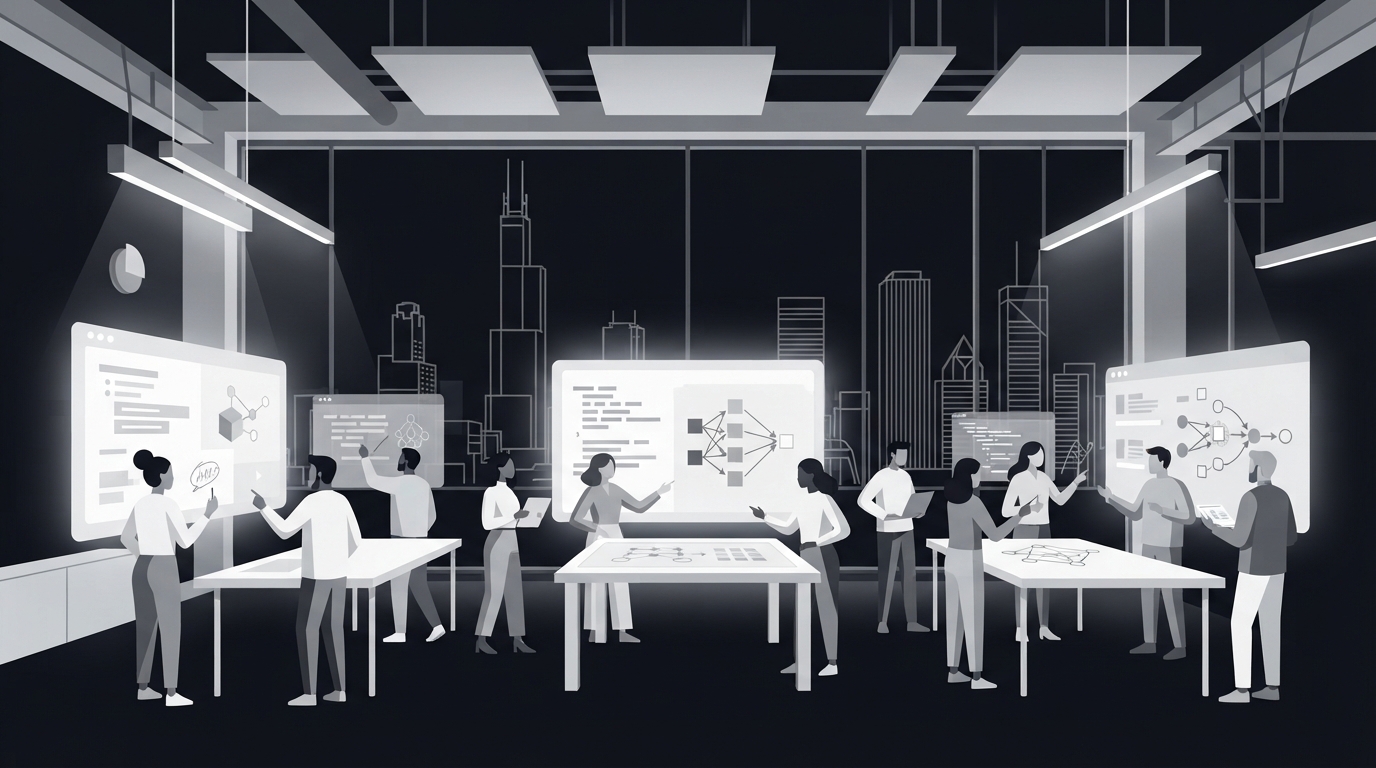
Chicago tech events offer practical value when you pick rooms filled with active builders rather than generic networking crowds. This guide covers nine communities and five 2027 conferences for software engineers, founders, and machine learning teams working in the city. I checked every schedule, price and venue on each organization's own page on 23 November 2026; where a page does not list a price or a venue, I say so. Use these options to find hands-on demos, product feedback, and production architectures that match your current engineering stage.
Which Chicago tech events fit an early-stage founder?
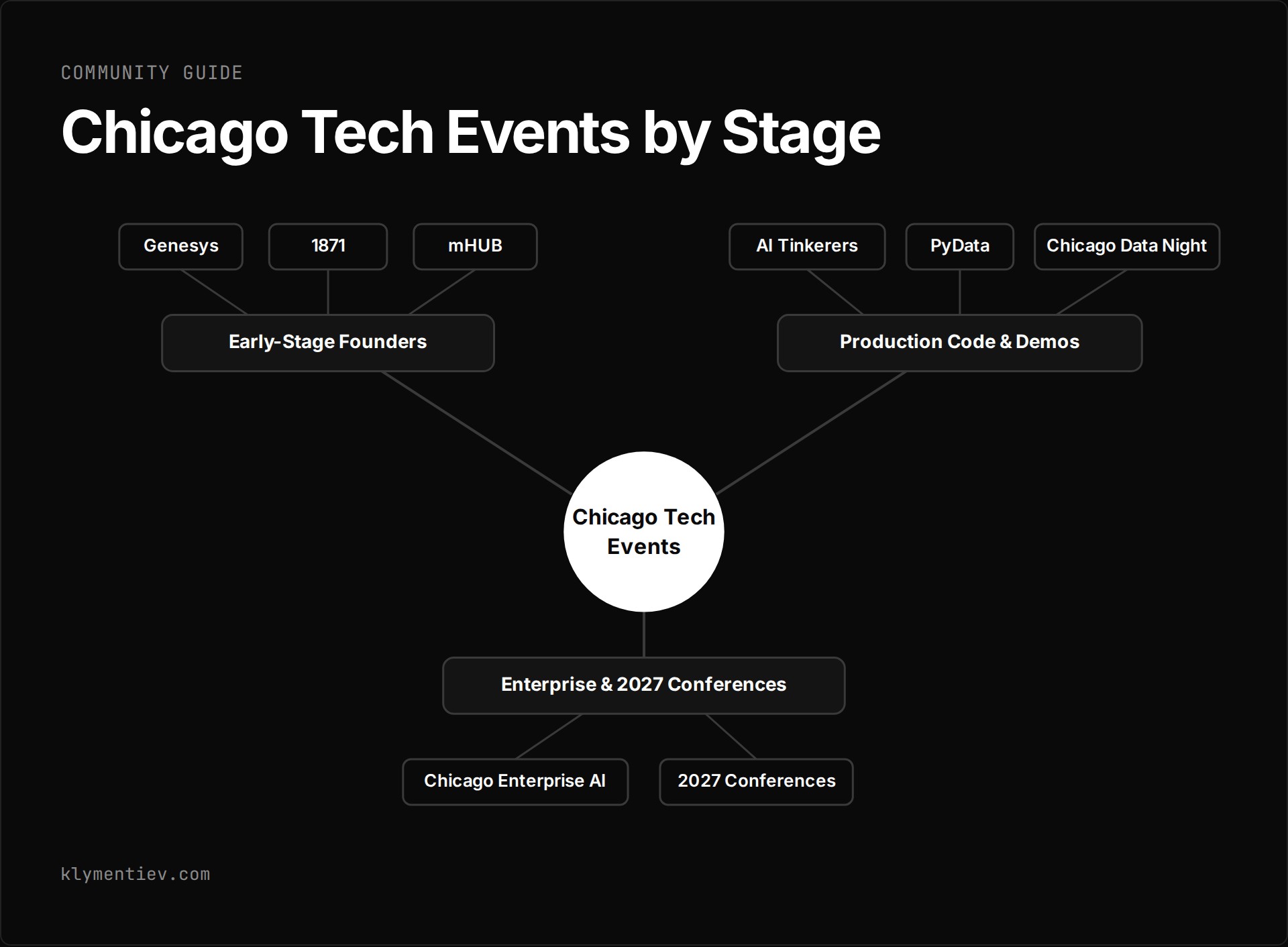
Building an early-stage company requires peers who test products, share operational lessons, and understand hardware or infrastructure constraints. Some AI meetups in Chicago are broad social mixers; the groups below either screen who comes in or are built around founders. The following three communities provide structured environments for founders validating new architectures and hardware designs.
- Genesys
An invite-only collective of practitioners based in Chicago who build, buy, and run artificial intelligence systems professionally. Founded by William Smith, a former Microsoft director of strategy and advisor across local incubators, the group focuses on vetting participants rather than accumulating passive attendees. Membership is free, with applications reviewed on a rolling basis on joingenesys.com and decisions returned by email, typically within two weeks. Programming includes working sessions, technical workshops, and quarterly in-person gatherings supported by an active Slack workspace and member portal. I attended its first in-person Chicago meetup on 23 November 2026 at mHUB. William Smith explained that he aims to maintain a focused cohort of about 50 strong practitioners alongside a small number of early-career contributors who help run initiatives, with plans covering regular gatherings, an educational curriculum for small businesses and developers, and a dedicated conference. Concrete example: The first in-person meetup on 23 November 2026 was a small room of practitioners and an open Q&A with the founder about where the group is going. Limit or mistake: The community requires an application review and host approval, which means you cannot buy a ticket and walk in the same week.
- 1871
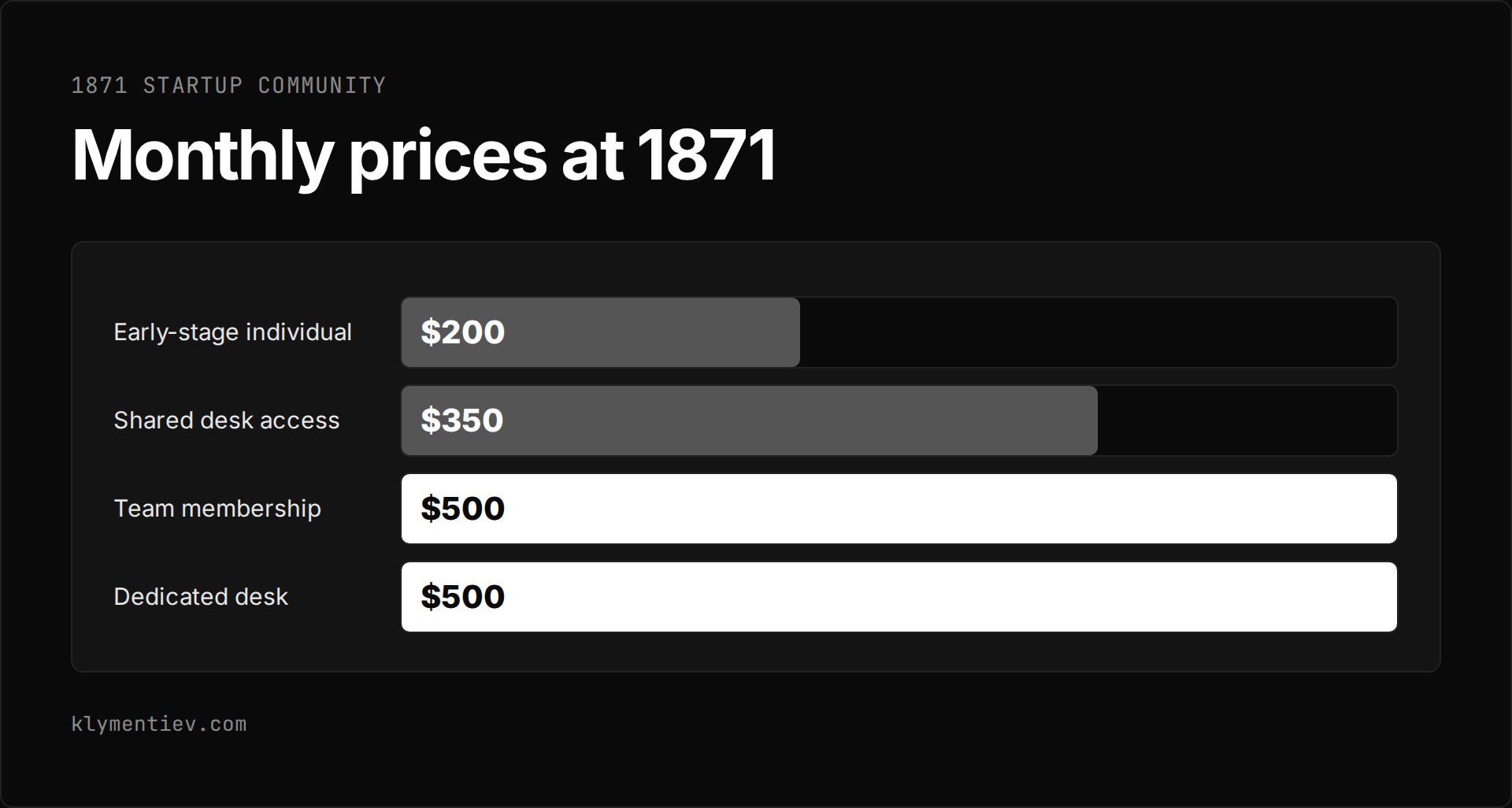
A long-standing nonprofit technology hub and startup community operating from 111 N Canal St on the 12th floor. The organization hosts hundreds of events annually, ranging from technical panels and workshops to Innovation Summits, pitch competitions, and community gatherings. Early-stage individual memberships cost $200 per month or $2,000 per year, while team memberships cost $500 per month or $5,000 per year, with optional shared desk access at $350 per month or dedicated desks at $500 per month. Public tickets for recurring events on its calendar, such as Tech The Halls or TechPalooza, sell for $15, whereas specialized summits range from $100 to $150. I am an 1871 Early Stage member, accepted in August 2026 with orientation in September 2026. I attended the opening of the new 111 N Canal St space on 15 October 2026 with a free member code, and members can request free codes for ticketed gatherings like the 9 December holiday party by contacting the events team directly. Concrete example: Tech The Halls, the annual holiday party on 9 December 2026, costs $15 on Luma; the event page itself tells members to ask events@1871.com for a free code. Limit or mistake: Relying on the public about page leads to outdated information, as older documentation still lists the historic Merchandise Mart address instead of the active 111 N Canal St facility.
- mHUB
A nonprofit (501c3) innovation center for hardware and physical-product startups, located at 1623 W Fulton Street. It runs prototyping labs, incubation and accelerator programs, industry partnerships and a venture fund. Programming includes member happy hours, workshops, office hours, an annual parking-lot barbecue, and the annual HardTech Summit featuring the Revolution Awards each March. The space serves hardware designers, mechanical engineers, and founders integrating machine learning into physical devices. Membership requires an application process and direct inquiry, as specific tiered pricing is not published on public pages. Concrete example: The next HardTech Summit and Revolution Awards are on 4 March 2027; before that, mHUB lists a member happy hour on 24 November and a Holiday Gift Lab on 10 December 2026. Limit or mistake: The facility is built specifically around physical prototyping equipment, making membership unnecessary for developers building pure cloud software without hardware components.
What if you write production code and want live technical demos?
Engineers implementing model inference, data pipelines, and distributed backends need deep technical exchanges without sales pitches. Among the practical tech meetups Chicago hosts, the most useful rooms are the ones where people show running work. The following three communities focus on code walkthroughs, data engineering, and terminal demonstrations.
- AI Tinkerers Chicago
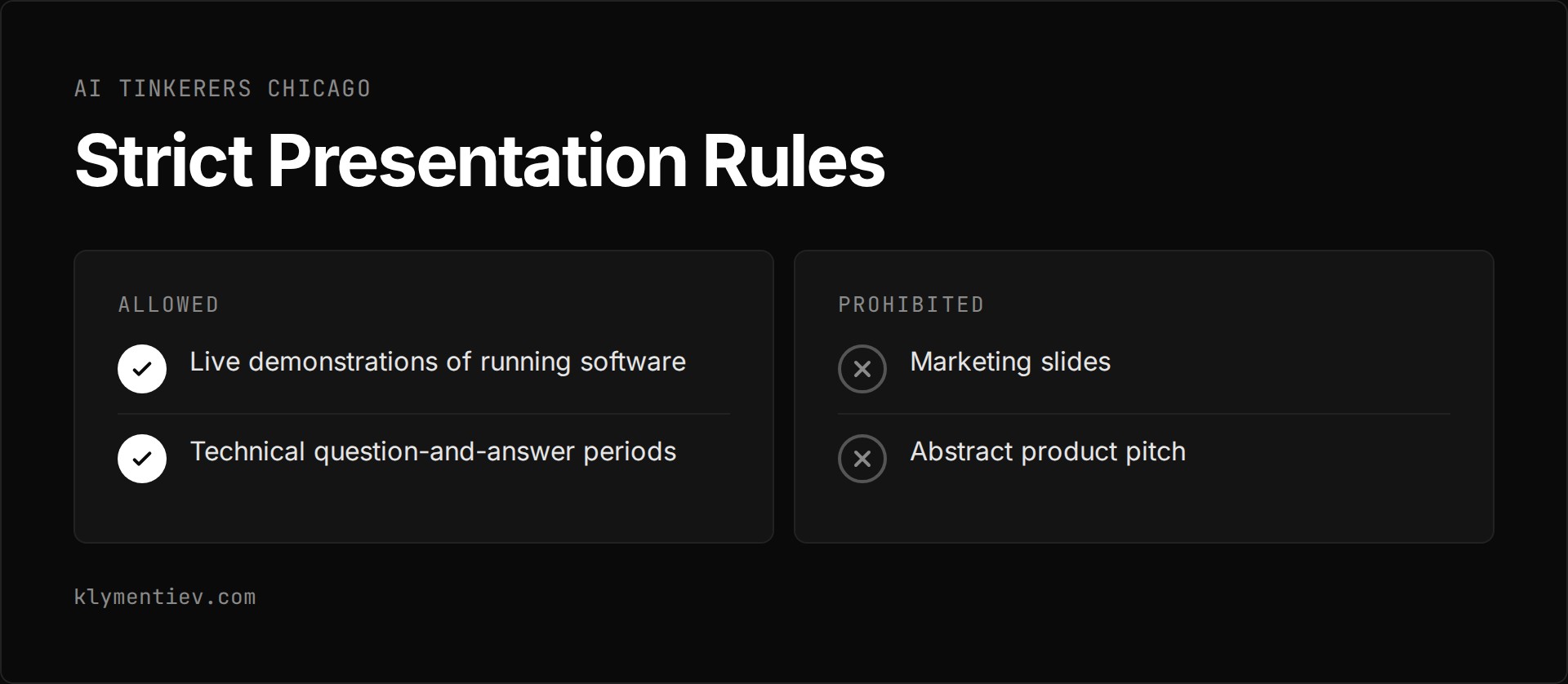
The local chapter of an international network organized around live demonstrations and technical problem-solving. Meetings run roughly monthly (11 in the last 12 months), about three hours in the evening, frequently hosted at offices like Drive Capital. The organizers enforce a strict screening process during registration on chicago.aitinkerers.org to confirm that attendees do hands-on AI work. The format follows a strict rule: no marketing slides, only live demonstrations of running software followed by technical question-and-answer periods. I attended the October 2026 meetup, where technical presentations covered Antithesis software testing and multi-agent execution patterns on cloud infrastructure. Concrete example: The October 2026 meetup featured talks from Antithesis and AWS; in mid-November the chapter also ran a three-day local AI hackathon (13 to 15 November). Limit or mistake: Showing up with marketing slides or an abstract product pitch violates community standards, and the screening at registration exists to keep the room technical.
- PyData Chicago
A monthly community meetup supported by NumFOCUS that brings together software developers, data scientists, and quantitative analysts using Python, Julia, R, and systems languages. The chapter includes over 6,700 members on Meetup and convenes on the last Thursday of each month at 6:00 pm. Sessions use a hybrid format with in-person presentations held across rotating downtown venues, including the Merchandise Mart and 200 N LaSalle St. Talks cover Python and data work in general, with AI topics in the mix. Event registration is handled through the public Meetup group without entry fees displayed on the event pages. Concrete example: The November 2026 session, "How AI Can Enhance Survey Research", drew 100 attendees. Limit or mistake: Topics vary widely across scientific computing and data analytics, so developers interested only in language models will find some months less relevant.
- Chicago Data Night
A monthly evening lecture and discussion series organized by the University of Chicago Data Science Institute since autumn 2023. The events run through the academic year from September through May, pausing during the summer months, and convene at 5:30 pm. Attendance averages around 75 people per session, with industry practitioners representing roughly 60 percent of the room alongside academic researchers and civic technologists. Recent sessions have gathered at TechNexus on the 12th floor of 20 N Wacker Drive, with one guest speaker per night. Registration is open to the public through its Meetup group, which maintains over 3,300 members. Concrete example: Royal Hansen of Google spoke on 18 November 2026 to 129 attendees; Harper Reed, former CTO of Obama for America, spoke in October. Limit or mistake: The series halts completely between June and August, meaning you cannot rely on it for technical networking during the summer season.
What if you deploy inside large companies or have limited time?
Engineers and managers operating within existing enterprises face compliance requirements, vendor security assessments, and complex integration lifecycles. When ongoing monthly schedules conflict with delivery deadlines, concentrated annual tech events and specialized industry forums offer an efficient alternative. The following options balance commercial deployments, city-wide gatherings, and dedicated annual conferences.
- Chicago Enterprise AI
A specialized Meetup group with nearly 6,000 members organized around the challenges of moving artificial intelligence from experimental pilots to corporate production. While the group occasionally hosts in-person technical sessions at spaces like Loft on Lake at 1366 W Lake St, the majority of its schedule consists of vendor-sponsored online webinars. These remote sessions are often run by vendors such as Google, Oracle and AWS. Concrete example: Its last in-person evening was a Data+AI meetup with Databricks on 10 November 2026; the next three listed sessions are online. Limit or mistake: Most scheduled events are virtual product demonstrations sponsored by commercial software vendors, so expect corporate presentations rather than independent community discussions.
- Startup Grind Chicago
The local branch of the global startup network, counting over 13,000 registered chapter members. The group organizes monthly events, including virtual workshops, fireside chats, and pitch competitions like Startup Mania. Becoming an official chapter member is free on its platform, with a mix of free online webinars and in-person events; the chapter page does not list venues. The focus is founders and investors rather than engineering. Concrete example: Startup Mania III, its pitch tournament, is on 24 March 2027, with a free virtual info session on 1 December 2026. Limit or mistake: Presentations focus on commercial strategy and investment mechanics, providing minimal utility for developers seeking guidance on low-level system design or code optimization.
- TechChicago Week
An annual week-long platform hosted every July across Chicago and Illinois, coordinated by the nonprofit organization P33. Rather than operating as a single convention, the platform promotes independent events that anyone can submit, and many are free. The 2026 edition listed 135 events. Dates for the 2027 edition are set for 19 July through 25 July. Concrete example: 1871 runs its TechPalooza during the week; other hosts set their own prices and audiences. Limit or mistake: There is no universal event badge, meaning you must register individually on separate ticketing platforms for every single session you plan to attend.
If you are looking for an AI conference in Chicago in 2027, expect little public pricing: none of the five below lists a ticket price on its own page, and several are invite-only or apply-to-attend. All five are in 2027:
- Chicago AI Week Summit 2027: Organized by AI 2030 in partnership with 1871, this is the fifth edition of a summit for AI leaders from industry, government and academia, with a focus on responsible AI. Official pages confirm the event for June 2027, featuring an industry day, investor pitch sessions, and a dedicated Women in AI Forum. Specific ticket prices are not displayed publicly, and the precise venue address requires approved registration.
- Leaders In AI Summit Chicago 2027: Hosted by the Institute for AI Transformation on 21 September and 22 September 2027. The conference targets senior executives and enterprise AI leaders, and its Think Tank Dinners are invitation-only. The venue is still to be announced, and the ticket page shows no prices.
- DataIQ 100 Summit North America 2027: Scheduled for 13 May and 14 May 2027 at the Marriott Marquis Chicago. It brings together senior data and AI leaders for a day and a half of practitioner-led discussion. Attendance requires an application process, with pass costs omitted from public announcements.
- Responsible AI Summit North America 2027: Organized by the AI, Data and Analytics Network of IQPC, taking place on 22 June and 23 June 2027 at the DoubleTree by Hilton Hotel Chicago on the Magnificent Mile. It is a closed-door gathering for senior leaders responsible for AI governance, security and risk, now in its second year; no price is shown.
- Stigler Center 2027 Conference: Run by the University of Chicago Booth School of Business on 15 April and 16 April 2027 at the Gleacher Center at 450 N Cityfront Plaza Dr. Titled "Will AI Kill Markets (and Democracy)?", this gathering convenes economists, legal scholars, and technologists. In-person attendance is strictly invitation-only, but all sessions are streamed and recorded.
Frequently asked questions
How do you verify if a local meetup is still active?
Check the date of the group's most recent gathering before signing up or planning your evening. Some AI meetups Chicago builders used to join, such as MLOps Community Chicago or aichicago, now return "Group not found" on Meetup. An active organization lists an event hosted within the past two months or displays a scheduled date on its calendar. If the group has not scheduled an in-person meeting for over six months, the organizer has likely paused operations.
How can members get free access to paid hub gatherings?
Inquire with community management teams about promotional redemption codes before buying public tickets on external event sites. For example, the public ticket for the 1871 holiday party costs $15 on Luma, and the event page tells members to email events@1871.com for a free code; I got a free member code for the October opening the same way. 1871 membership also includes complimentary tickets to its Innovation Summits.
What should you expect from an AI conference Chicago hosts in 2027?
Attending a Chicago AI conference in 2027 requires verifying venue locations and tier requirements in advance. Of the five 2027 conferences in this guide, none publishes a ticket price, one hides its venue until registration and one has not announced it yet. If you cannot get in, the Stigler Center conference at the Gleacher Center is invitation-only but streams and records its sessions.
Finding the right technical community in Chicago comes down to selecting rooms that value engineering substance over networking volume. Filter groups by their recent activity dates, verify whether access requires host approval or an application form, and check membership benefits before buying single-event tickets. Whether you spend your evenings troubleshooting models at live demonstration nights, reviewing system architectures in closed working sessions, or tracking enterprise deployments at annual conferences, choose rooms that align with the software you are shipping today.