
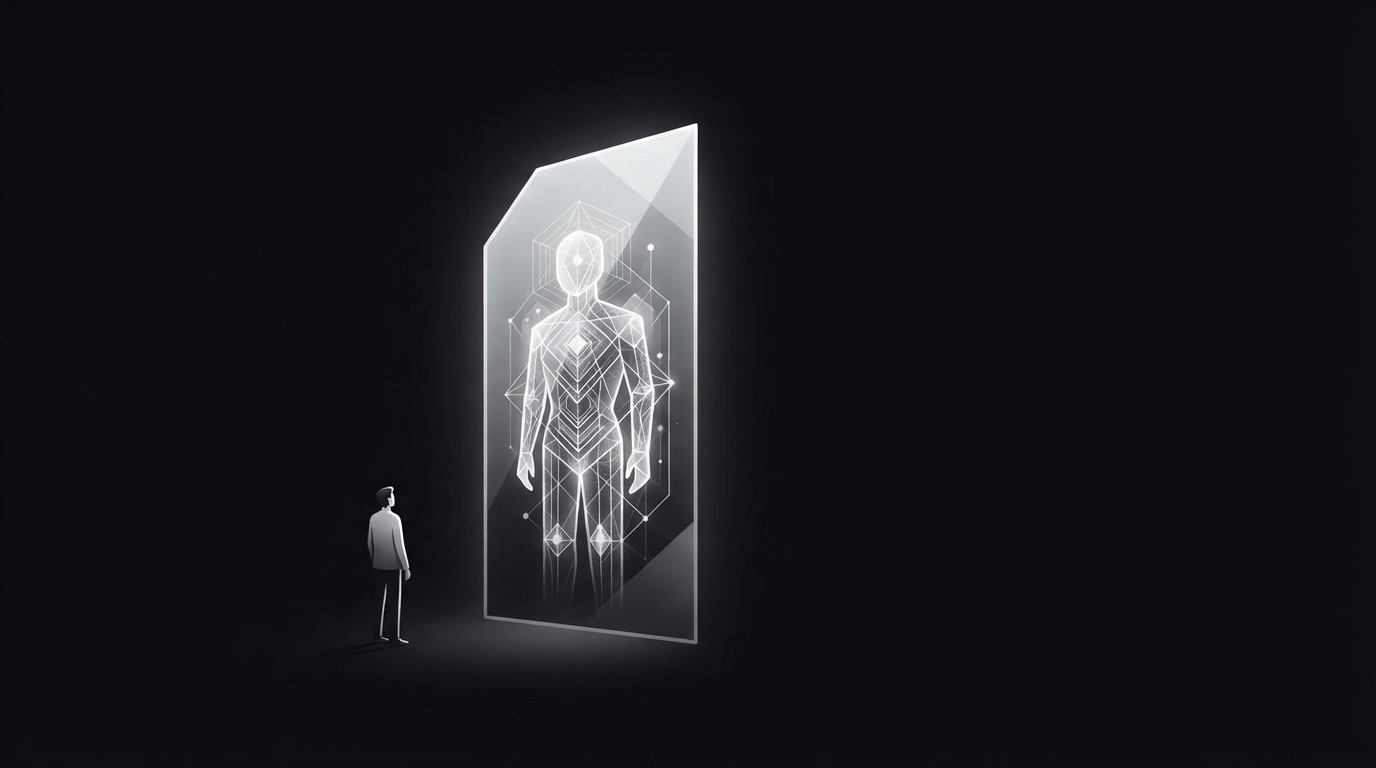
Artificial intelligence is your mirror. The more you know and the clearer your head, the more AI gives you. If you do not understand the subject, it will not help you much, because you cannot ask the right question, judge the answer, or notice the mistake. And the mirror shows two things at once: what you know, and the state you are in right now.
Why is AI a mirror and not an equalizer?
The model reflects your own depth and leaves your unstated assumptions exposed when you lack the knowledge to inspect the output.
In my work building AI systems, the most common mistake I see is treating a model as an independent mind that will supply the competence you lack. That view ignores how these tools work. A model takes your prompt, matches it against what it learned, and returns a plausible continuation. If you bring a thin understanding, your prompt is vague and the response is superficial. You accept it because you cannot spot the errors.
Dell'Acqua et al., in a Harvard Business School working paper from 2023, studied 758 BCG consultants using GPT-4. On tasks inside what the authors call the capability frontier, participants completed 12.2 percent more tasks, worked 25.1 percent faster and produced work of more than 40 percent higher quality. Consultants below the average threshold improved by 43 percent, those above it by 17 percent. Yet on a task outside that frontier, consultants using AI were 19 percentage points less likely to reach a correct solution.
The mistake is assuming that because a model sounds fluent, it knows the boundaries of its own competence. It does not. When you push it into territory where it guesses, a weak prompt invites confident nonsense. If you lack the knowledge to recognize that boundary, you walk off the edge with the tool leading the way.
Does AI help experts or novices more?
Simple tasks favor the novice by lowering the entry barrier. What you keep afterwards, and whether you notice a wrong answer, depends on what you already know.
People often ask whether AI helps experts or novices more. The honest answer is that the early data points the other way from my thesis, and it is worth looking at why. Noy and Zhang studied 453 college-educated professionals in 2023 and found that ChatGPT cut writing time by 40 percent, raised quality by 18 percent and reduced inequality between workers, on short artificial tasks. Brynjolfsson, Li and Raymond examined 5,179 customer-support agents (Quarterly Journal of Economics, 2025) and found that issues resolved per hour rose 14 percent on average, 34 percent for novice and low-skilled workers, with minimal impact for experienced ones. But that tool had been trained on the behavior of top performers, so it passed the experts' know-how to beginners. The expertise was in the mirror before the novice looked into it.
The picture shifts when you ask what people keep. MIT economist David Autor and six colleagues studied 133 patent lawyers at 11 US intellectual property firms in a three-month randomized trial, published as an NBER working paper in 2026 and conducted by Google. AI raised the quality of delivered work by 0.34 standard deviations at 10 days and 0.38 at 90 days, with larger gains for juniors. Then everyone did a final task without AI. Treated lawyers beat the controls by 0.32 standard deviations, and the advantage came entirely from senior lawyers, who gained 0.45. Juniors showed no average gain; their scores split into more poor results and more good ones. The authors conclude that foundational expertise may be a prerequisite for extracting durable skill from AI-assisted practice.
The mistake is treating an output boost as skill. Novices get the immediate gain on structured tasks where expert behavior can be scripted. Take the tool away, and what remains is what you brought.
How does your cognitive state change what the tool reflects?
Attention, fatigue, hurry and the temptation to hand over your thinking decide whether you steer the model or simply repeat its guesses.
This is the second half of the mirror, and the one people talk about least. Expertise changes over years. Your cognitive state changes over a day: how focused you are, how tired, how rushed, and whether you are thinking about the problem or handing the thinking over. The same person gets a different AI on a Monday morning and on a Friday night.
On fatigue and hurry there is less research than I expected, and it points the same way. In a Monash University experiment (Fraser et al., Ergonomics, 2013), 19 people were tested rested and after a night without sleep; sleep-deprived, they were less able to use a decision aid under time pressure. In a 2024 experiment by Rosbach et al., 28 trained pathologists estimated tumor cell percentages with AI advice: the AI raised their overall accuracy, but in 7 percent of cases its wrong advice overturned a judgment that had been correct, and time pressure made that effect more severe. A 2010 review of automation research by Parasuraman and Manzey found that people stop checking automated systems when other tasks compete for their attention, that this happens to experts as well as novices, and that simple practice does not cure it. A good state is not a bonus on top of expertise; without it, expertise does not get used. These studies are about decision aids, not chat models, so the rest is my view from daily practice. When I am tired, I stop writing precise questions and start treating the first answer as finished. Confidence in the model rushes in to fill the gap left by my own attention.
Two studies touch the rest of it. Lee et al. (Microsoft Research and Carnegie Mellon, CHI 2025) surveyed 319 knowledge workers about 936 real examples. Higher confidence in generative AI went with less critical thinking; higher confidence in oneself went with more. It is a self-reported survey and shows correlation, not cause. Critical thinking did not disappear; it moved toward verifying, integrating the output and stewarding the task. Kosmyna et al. at the MIT Media Lab recorded EEG from 54 people writing essays with an LLM, with a search engine, or with nothing. Brain connectivity scaled down with the amount of outside help, and the LLM group showed the weakest connectivity and the lowest sense of ownership of their essays. People who first wrote on their own and then used the LLM showed higher memory recall. It is a preprint with a small sample, but the direction matches what I see: thinking first, then asking, gives a different result from asking first.
The mistake here is cognitive offloading: you let the system do the thinking while you watch. It is most tempting exactly when you are tired, which is when you are least able to catch what it gets wrong.
Why do even experienced people misread the mirror?
Feeling faster and being faster are different measurements, and experts are not immune to confusing them.
METR ran a randomized trial in 2025 with 16 experienced open-source developers working on 246 tasks in their own repositories. Before the trial they forecast that AI would cut their time by 24 percent. Tasks took 19 percent longer with AI. Afterwards, the developers still believed it had made them 20 percent faster.
The study measured the gap but did not establish its cause. My reading is that generating feels fast while checking is slow and easy to forget. Expertise lets you check, but it does not stop you from misjudging how much checking you did. This is where state and expertise meet: an expert who is rushed sees a reflection of speed, not of results.
The mistake is confusing generation speed with completion speed. If you do not measure, your sense of how much AI helps you is one more reflection, and not an accurate one.
How does the system act as an amplifier?
Deep knowledge lets you push a model past its default answer; without it, the first plausible response is where the conversation ends.
In my view, AI amplifies expertise in the hands of people who know how to interrogate the output. When you understand the domain, you notice what is off in the generated text or code, catch more of its mistakes, and ask for the next iteration instead of accepting the first one. You use the tool to explore edge cases and test a design, not to produce what you could not judge.
Without that knowledge the interaction stays on the surface. If you do not know what a correct answer looks like, you cannot steer the model toward one, and you have no reason to doubt the one you got.
The mistake is believing that the tool supplies the expertise. It reflects your capacity to ask hard questions and to check the answers.
How do the principles fit together?
- Expertise sets the ceiling. What you know decides the question you can ask and the judgment you can apply to the answer.
- Task difficulty decides who gains. Novices gain most on routine, well-defined work; durable skill and correct answers outside the frontier depend on knowledge you already have.
- Cognitive state governs the day. Fatigue, hurry and handing over your thinking lower your engagement and your chance of catching an error.
- Your sense of the gain is also a reflection. Measure it; do not trust the feeling.
Frequently asked questions
Does AI make novices better at complex tasks?
Not reliably. Randomized studies show that novices gain speed and output on structured, routine tasks where expert behavior can be imitated. On a task outside the capability frontier, consultants using AI in the Harvard Business School study were 19 percentage points less likely to reach a correct solution.
Why do experienced professionals overestimate how much time AI saves them?
The METR study measured the gap but did not establish its cause: developers forecast a 24 percent speedup, were 19 percent slower, and still believed they had been 20 percent faster. My reading is that generation feels fast while checking the result is slow and easy to forget.
Can you build durable skills by practicing with AI assistants?
In the patent-lawyer trial led by David Autor, only senior lawyers kept a measurable advantage when the AI was taken away; juniors showed no average gain, with results split both ways. The authors suggest that foundational expertise may be a prerequisite for durable skill from AI-assisted practice.
How does fatigue change your work with AI?
With chat models it has barely been studied, but experiments with decision aids point one way: sleep-deprived people used a decision aid worse under time pressure (Fraser et al., 2013), and time pressure made the effect of wrong AI advice on pathologists more severe (Rosbach et al., 2024). In my experience, when I am tired or rushed, I write vaguer prompts, check less, and accept plausible errors more often. Doing the thinking first and keeping hard reviews for when I am rested helps more than any prompt trick.
When you sit down to work with AI, the tool reflects what you bring to the session: your knowledge and your state. Before you open the prompt box, write your own answer or plan. Ask the model where its answer is most likely wrong, do not accept answers in a domain you cannot check, and keep your heaviest review work for when you are rested.
