
outbid.lol took $181,804 from 1,188 companies in its first four days, and is past $222,000 on day seven. I captured all 1,188 rows at hour 89.
- Ten listings paid 56% of the money. The median listing paid $5.
- A click cost about $1.59 all the way from $15,000 down to $24. There was no premium at the top and no bargain in the middle.
- The board's click counter stops being a measurement below rank 250.
- Every listing link carries
rel="sponsored", so none of it passes SEO value. - 254 copies of the site appeared in four days, 394 by the next morning. The median one earned nothing.
Or take the capture it is built on: all 1,188 rows as JSON (21 KB).
The post that started it was unremarkable: a developer saying, on a Tuesday evening, that he had bought a domain. Four days later the site on it had taken $181,804 from 1,188 companies, and roughly 250 copies of it existed. By the time I finished writing this it was past $207,000.
It has been picked over by everyone at this point, and I couldn't leave it alone either. I wanted the actual numbers, so before the wave passed I captured the whole board: all 1,188 rows, on day four, at hour 89. Rank, price, category, and the clicks each listing reported.
One thing in there changed how I read the whole story.
The board is not a crowd
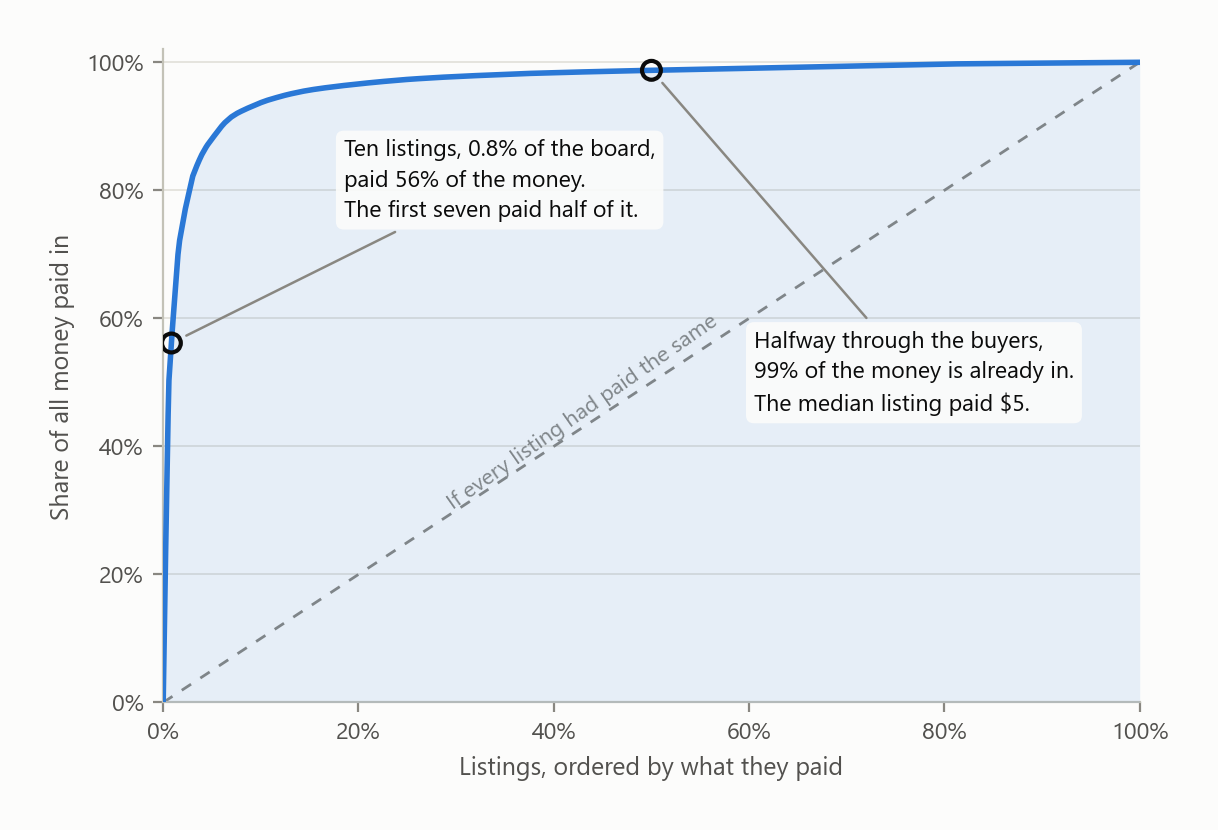
Ten listings paid $102,084 of the $181,804. That is 56% of the money from 0.8% of the board.
The median listing paid $5. Six hundred and thirty-nine of them, 54% of the board, paid five dollars or less, and between them they account for $2,506, which is 1.4% of the total. Run it from the other end and the shape is the same: by the halfway point of the board, 98.7% of the money is already in.
So "1,188 companies paid" is true and tells you almost nothing. This was a handful of large purchases with a very long tail of participation attached, and the tail is what made it look like a market.
Should you build one
Only if you already have the audience, and then the board is not the point.
254 people built the same thing inside four days and the median one earned nothing. Five days in there were 394 of them. What could not be copied was nineteen thousand followers who had spent two days watching him look for something to build, and a willingness to post the outage, the broken analytics and the hosting bill as they happened.
Should you buy a place on one
Only against your real cost per click, and only with a ceiling decided before the first payment.
The credible range is around $1.59 a click for untargeted traffic that bounces at 75% and stays 57 seconds. There is no search value: every listing link on the board carries rel="sponsored", which passes no ranking weight by design. I checked all fifty on the first page.
And the top of the board bought attention at a bad price. The $15,000 spot was not the most clicked listing: five listings reported more clicks than it did and every one of them paid less, the cheapest at $1,305. That is nine cents a click against $1.30. All six sit above rank 250, where the board's counter still behaves like a measurement.
What is in the write-up
Twenty-two pages, and every figure in it opens its source.
- Minute by minute from an idea posted to an empty timeline to a live product, every timestamp decoded from the id of the post rather than read off a label
- Where the money came from, by slice and by category
- What a click actually cost, band by band, and why click counts below rank 250 cannot be believed
- What $15,000 bought, taken apart into search value, traffic, and what buyers say they got against what the board says they got
- The copies, and the two registries that cannot agree with each other
- A chapter listing every claim I could not verify, plus the eight figures I printed wrong before correcting them
Or take the capture it is built on: all 1,188 rows as JSON (21 KB).
The capture ships with the document. Part II is arithmetic on that file and nothing else, so you can recompute any figure in it, including the ones that disagree with the coverage. The zip carries a README describing how it was taken and what it is not.
This board gets read again
Day 7, then 14, 30 and 90. Same method, same file, because the interesting question about a wave is not how high it went.
Those readings go out from here, and I post them as they land at @dklymentiev.
